What creative intelligence actually is
Creative intelligence is tagging creative attributes, correlating them with paid media performance, and recommending what to make next. That is the category. Everything else adjacent to those three jobs (production tooling, asset management, creative automation) is being sold under the same label, which makes buyer research harder than it should be.
The useful definition is narrow. If a vendor does not tag attributes, does not correlate with outcomes, and does not recommend, they are not a creative intelligence platform. They are something else. That cut eliminates roughly half the noise in a normal buyer RFP.
Creative intelligence is a rear-view mirror. It tells you what worked. Predictive infrastructure tells you what will work before it ships.
Why the category exists
Three forces created creative intelligence around 2017 to 2019. Brands started producing thousands of variants per campaign to feed programmatic platforms. Ad platforms (Meta especially) pushed creative volume as the lever for performance. Attribution got noisier with iOS 14 and cookie deprecation. Somebody had to answer "which attributes drive results."
The category filled that gap. It mapped dimensions of creative (first-frame hook, logo presence, human face, music genre) to outcomes (CTR, ROAS, brand lift). It was useful. It is still useful. The limits are structural, which is where predictive infrastructure comes in.
The ten platforms that matter
Forrester's Q1 2024 Creative Advertising Technologies Landscape[1] named thirty-one vendors. The ten that actually matter for buyer decisions today:
| Platform | Funding | Focus | Signal |
|---|---|---|---|
| VidMob | $185M total ($110M Series D 2022) | Agile Creative Intelligence, Meta-validated taxonomy (~120 attributes) | Paid social tagging |
| CreativeX | $25M Series B 2022 | Brand-guideline compliance scoring | Creative Quality Score |
| Marpipe | $8M Series A 2021 | Multivariate creative testing for DTC | A/B at scale |
| Memorable (Reddit) | Acquired by Reddit late 2024 | Neuroscience-based memorability scoring | Powers Reddit Ads |
| DAIVID | £4M seed 2022 | Emotional response + attention via webcam + survey | Effectiveness benchmarks (50K ads) |
| Pencil (Brandtech) | Acquired by Brandtech 2022 | Gen-AI creative + outcome prediction | Mondelez 53% lower cost-per-creative |
| Smartly.io | Private equity owned | Creative production + automation | Enterprise creative ops |
| Celtra | PE owned | Creative management + analytics | Ad production scale |
| Bannerflow | PE | Creative management + analytics | EU enterprise |
| Rembrand | $24M Greycroft 2023 | Generative in-video product placement | Adjacent to measurement |
The honest comparison
Buyer-relevant axes that separate the category: input type (raw asset versus campaign data versus both), tagging taxonomy (proprietary versus platform-validated), prediction capability (pre-launch forecast yes or no), integrations (Meta, TikTok, Google, CTV), and pricing tier (mid-market SaaS versus enterprise).
What none of them does natively: neural-response forecasting for unreleased creative, cross-cultural zeitgeist relevance, and end-to-end calibration against published field outcomes. Those three gaps are the opening for predictive infrastructure.
Published case studies worth reading
Unilever and CreativeX. Unilever publicly reported lifting Creative Quality Score from 24 percent to 67 percent, which drove 66 percent higher ROI on roughly $5B in measured media[2]. Heineken reported a 75 percent improvement in Creative Quality Score after rollout.
P&G/Olay and VidMob. A 2023 case study reported a 31 percent lift in attention metrics and a 17 percent sales lift tied to VidMob tagging recommendations[3].
Mondelez and Pencil. Gen-AI creative production cut cost per creative by 53 percent and lifted output volume by 30 percent[4].
DAIVID benchmarks. 2024 Creative Effectiveness Benchmarks scored 50,000 ads and published distribution data that is useful across the category, not only for DAIVID customers[5].
The structural limit
Attribute-label-correlate only works for creative similar to what has been tested. Three breakdowns are consistent across vendors:
- Novel formats. Short-form vertical video broke taxonomies built on 16:9. Interactive CTV is doing the same thing now.
- Novel cultural moments. Attributes trained on pre-2023 TikTok do not capture 2026 audio trends.
- Label fatigue. Past a certain point, adding more tags does not add predictive power. VidMob reports diminishing returns above roughly 120 attributes.
The deeper issue: creative intelligence predicts based on similarity. Genuinely new creative, by definition, has no similar prior. That is where single-signal systems hit their ceiling (see the four signals framework).
What predictive infrastructure adds on top
Predictive infrastructure is not a creative intelligence competitor. It is the layer above. It takes the outputs of CreativeX, VidMob, Memorable, DAIVID, and adds:
- Neural signal. Forward encoding models predict cortical response without needing a tagged prior (see TRIBE v2 explained).
- Linguistic affect. Phrasee, Persado, and LLM-native approaches score the text layer separately (see the scoring framework).
- Cultural relevance. Live conversation proximity via trend data, memetic salience, and platform currency signals.
- Historical benchmarking. Ad library archives (see the Meta Ad Library guide) and paid social benchmarks (see benchmarks).
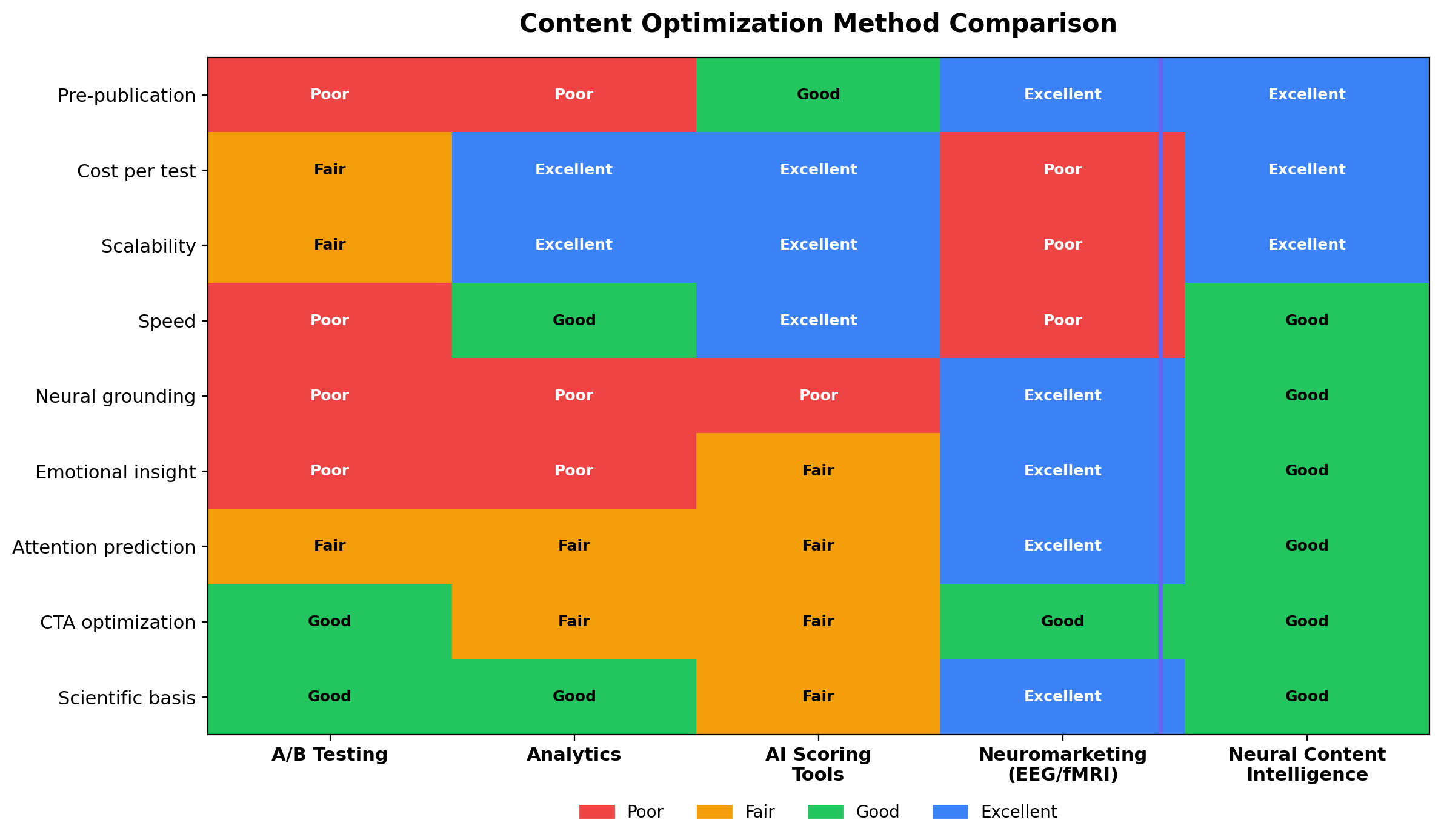
OpenAffect sits on the fusion layer. We are not trying to rebuild VidMob's tagging stack. We take that tagging as one input, add three other signal families, and calibrate the composite against public outcome data.
How to pick
- Brand-guideline compliance problem? CreativeX.
- Paid social performance tagging problem? VidMob or Marpipe.
- Memorability or emotion problem? DAIVID or Memorable (Reddit).
- Generative production tied to prediction? Pencil.
- Need all of the above plus forecasting? You do not need another vendor. You need the fusion layer on top.
Pick a creative intelligence platform for the category it already solves. Do not expect any of them to do all four signal families. That is not their architecture.
References
- 1Forrester. Creative Advertising Technologies Landscape, Q1 2024.
- 2CreativeX. Unilever case study.
- 3VidMob. P&G/Olay case study.
- 4Pencil. Mondelez case study.
- 5DAIVID 2024 Creative Effectiveness Benchmarks.
- 6G2 Creative Management Platforms leaders 2025.
- 7eMarketer. Worldwide digital ad spending forecast.
- 8Reddit press. Acquisition of Memorable.
- 9Creatopy pricing.